
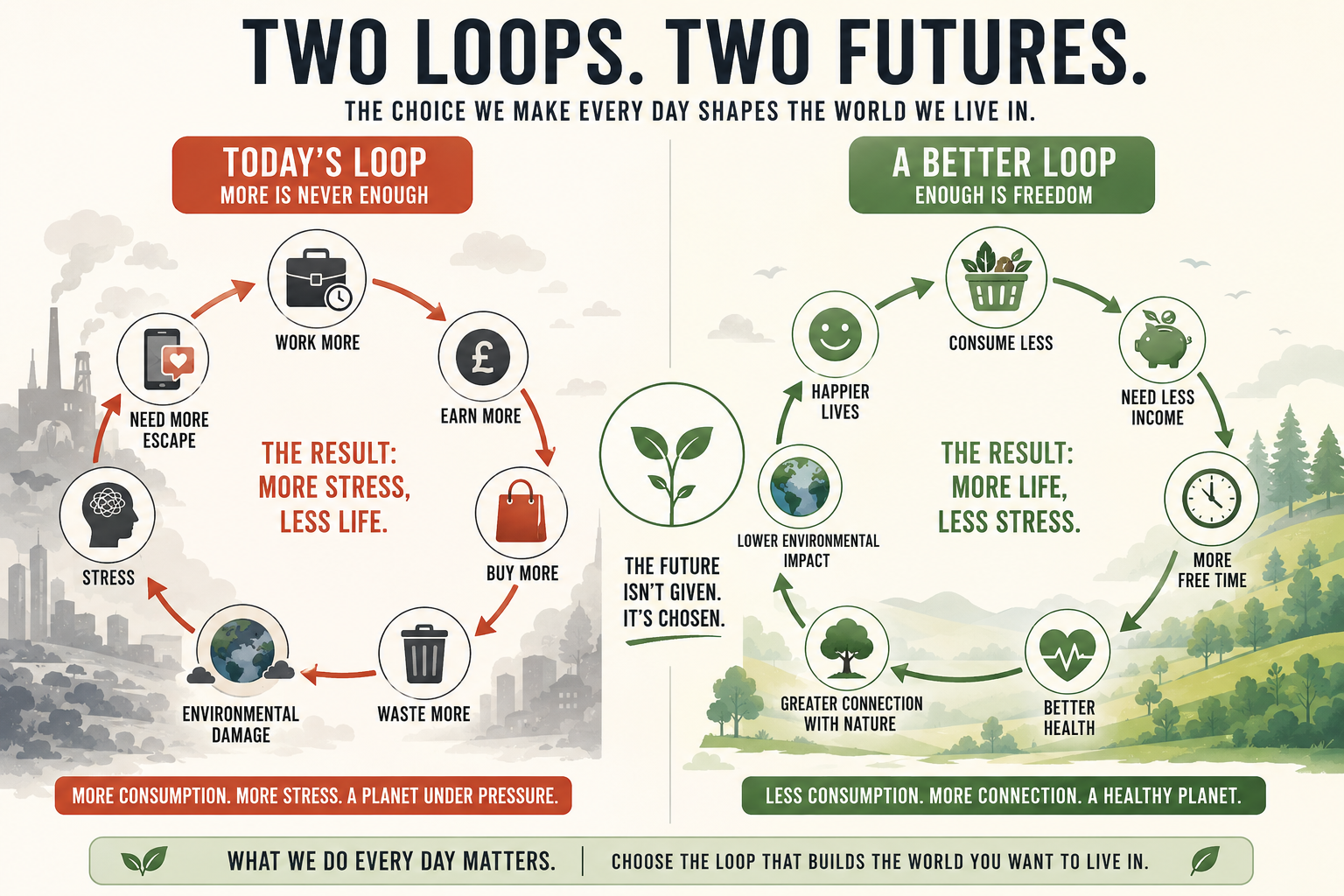
Many of the challenges facing modern civilisation appear different on the surface—climate change, declining mental health, loneliness, obesity, pollution, loss of biodiversity, job disatisfaction, unemployment, AI concerns, financial stress and political division. Yet they may all stem, at least in part, from the same underlying issue: a culture that encourages us to consume more, work more and accumulate more, often at the expense of our health, relationships and the natural world.
For decades, economic growth has been treated as the primary measure of success. While growth has delivered extraordinary advances in healthcare, technology and living standards, it has also created a system that constantly encourages us to buy things we don’t need, replace products before they’ve worn out and work longer hours to afford lifestyles that don’t necessarily make us happier.
Imagine if we measured progress differently.
Instead of asking, “How can we consume more?” we might ask, “How can we live better?”
That could mean consuming less—not through sacrifice, but by recognising that beyond a certain point, more possessions contribute very little to long-term happiness. It could mean working fewer hours where possible, giving people more time to spend with family, volunteer in their communities, exercise, create, learn, explore nature and simply rest.
Our purpose would shift towards activities that stimulate our minds, strengthen our bodies, build meaningful relationships and improve the places we live. Education, creativity, sport, health, fitness, music, conservation, craftsmanship, gardening, walking, caring for others and lifelong learning become markers of a life well lived rather than the size of a house or the latest car.
Interestingly, many of the activities that consistently bring people lasting happiness also happen to benefit society and the environment. Spending time outdoors improves mental health while increasing appreciation for nature. Walking, exercise and cycling improve physical fitness while reducing emissions. Playing sport builds friendships and health. Volunteering strengthens communities. Growing food reduces waste and reconnects people with the seasons. Repairing and reusing products reduces pollution while encouraging practical skills. Sharing experiences creates richer memories than accumulating possessions.
Rather than seeing environmental sustainability as a restriction, it becomes a natural consequence of living well. If we need less, we extract less. If we waste less, we pollute less. If we value experiences over possessions, our environmental footprint shrinks without reducing our quality of life.
This isn’t an argument against progress or innovation. Technology has transformed lives and will remain essential in solving many global problems. The challenge is ensuring that technological and economic progress serves human wellbeing instead of becoming an end in itself.
Perhaps the goal of civilisation shouldn’t simply be to maximise production and consumption. Perhaps it should be to maximise healthy years, meaningful relationships, resilient communities and a thriving natural world.
The striking thing is that these goals are not in conflict. More often than not, the things that genuinely make us happier—time with loved ones, meaningful work, creativity, movement, nature, community and purpose—are also the things that create a healthier society and a healthier planet.
Maybe the future isn’t about having more.
Maybe it’s about needing less, living better and recognising that true prosperity is measured not by what we own, but by how well we live.
Maybe it’s about consuming less, working less, putting our purpose to things that stimulate our mind, make our bodies healthy, on activities that are environmentally sustainable, connect us to others and truly make us happy?




0 Comments