
Reliable portable power for camping, wild camping, van trips and photography adventures.
When you’re spending time outdoors, particularly on longer camping trips or photography adventures, keeping your electronic equipment charged can become a bit of a challenge.
I spend a lot of time camping and exploring the countryside, often with plenty of electronic devices. Whether I’m heading into the Lake District for a few days, photographing landscapes, flying my drone or working on photographs back at camp, there’s an increasing amount of equipment that needs charging.
Cameras, drone batteries, laptops, phones, head torches and other accessories all rely on having a decent power supply.
That’s where portable power stations come into their own.
I’ve been looking at the AFERIY P180 Pro portable power station, a relatively compact unit offering a substantial 1024Wh battery capacity and 1800W of power output.
But is it actually a worthwhile investment for photographers, campers and outdoor enthusiasts? And how many times could it recharge the equipment we’re likely to take on an outdoor adventure?
Let’s take a closer look.
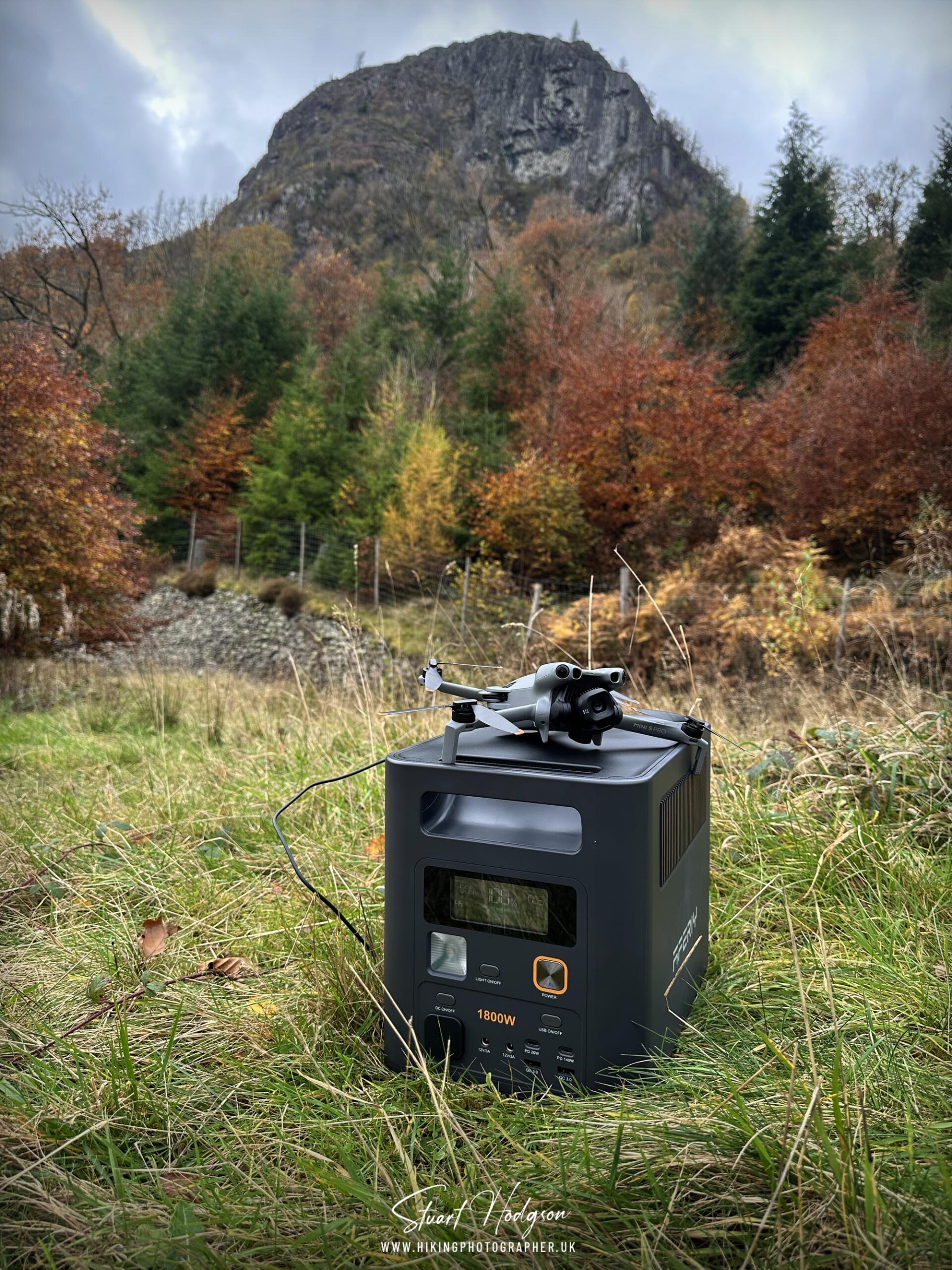
AFERIY P180: At a glance
The AFERIY P180 Pro is designed to provide portable electricity without needing to rely on a campsite hookup or mains power. It uses a LiFePO4 battery, which is generally regarded as a durable and long-lasting battery technology and takes around 1.5 hours to charge it up from mains electricity.
Here are the headline specifications.
| Specification | AFERIY P180 Pro |
|---|---|
| Battery capacity | 1024Wh |
| Continuous output | 1800W |
| Peak output | 3600W |
| Battery technology | LiFePO4 |
| Battery cycle life | 4000+ cycles |
| Weight | 11.64kg |
| AC sockets | 2 |
| USB-C | 140W and 20W |
| USB-A | 2 x 18W |
| Solar charging | Up to 500W |
| Mains charging | Up to 1000W |
| Warranty | Up to 7 years |
At just under 12kg, it’s not something you’d want to carry up a mountain, but it’s a manageable size for campsites, campervan adventures and even just photography day trips where you are just charging items from the car.
How many times can it charge your photography equipment?
This is probably the most interesting aspect of the P180 Pro for photographers.
A 1024Wh battery provides a considerable amount of stored energy. For the following estimates, I’ve allowed approximately 85% usable energy when charging through the AC sockets, giving around 870Wh available.
Actual results will depend on the equipment, chargers and charging conditions.
1. Charging cameras and photography batteries
If you’re anything like me, the last thing you want when you’re out photographing landscapes is to run out of camera batteries.
For photographers who spend several days outdoors, having the ability to recharge camera batteries is a real advantage.
Let’s assume a typical mirrorless camera battery has a capacity of approximately 15Wh – I make it youy could get around 58 charges of that battery from the AFERIY P180 Pro – so more than plenty, and enough to charge multiple batteries simultaneously.
The important thing is that even if you’re taking several spare batteries and shooting hundreds of photographs, the P180 has plenty of capacity for a typical multi-day photography trip.
You could easily recharge batteries every evening on a short camping trip without worrying too much about running out of electricity.
2. Charging drone batteries
For anyone who enjoys aerial photography, drones introduce another significant power requirement.
Drone batteries are relatively expensive, and having the ability to recharge them when you’re away from home means you need less batteries as tehy can be recharged and so you can spend more time flying and capturing those aerial landscape photographs.
As an example, let’s use a larger drone battery with an approximate capacity of 77Wh.
| Drone batteries | Estimated full charges |
|---|---|
| 1 drone battery | 11 |
| 2 drone batteries | 5 complete pairs |
| 3 drone batteries | 3 complete sets |
| 4 drone batteries | 2 complete sets |
Smaller drones, such as the DJI Mini series, which is what I have – have considerably smaller batteries, so you could potentially get many more charges.
Remember that charging a drone battery through its charging hub may introduce additional losses, so actual figures will vary.
For photographers who regularly fly drones on trips, this is a particularly useful feature.
3. Charging laptops
Photography doesn’t always stop when the camera goes back in the bag.
I often find that there’s work to do after a photography trip, whether that’s editing photographs, backing up memory cards, writing articles or organising images.
Being able to take a laptop along and work away from mains electricity is a real bonus.
The P180 Pro has a 140W USB-C output, which is particularly useful for modern laptops that support USB-C Power Delivery.
Assuming a typical laptop battery capacity of 60Wh:
| Laptop battery capacity | Estimated full charges |
|---|---|
| 50Wh | 17 |
| 60Wh | 14 |
| 70Wh | 12 |
| 80Wh | 10 |
These estimates allow for approximately 85% usable energy and are intended as a guide.
For most photographers, the ability to recharge a laptop several times over a camping weekend is more than enough.
You can also use the AC sockets for laptops with conventional mains chargers.
4. What if you’re charging everything together?
This is where the P180 Pro becomes particularly interesting for outdoor photographers.
Let’s imagine a typical photography camping trip.
You arrive at your campsite, set up your tent and spend the day exploring the surrounding countryside.
By the evening, you need to recharge:
-
Two mirrorless camera batteries (15Wh each).
-
One drone battery (77Wh).
-
One laptop (60Wh).
-
Your phone (15Wh).
-
A head torch (5Wh).
That’s approximately 187Wh of battery capacity to replenish.
With around 870Wh of estimated usable energy, the P180 Pro could theoretically provide around four complete rounds of charging for this equipment combination.
In other words, you could potentially spend several days away from mains electricity while continuing to use your photography equipment.
And that’s before considering the possibility of topping up the power station, either via the mains on the campsite somewhere, or stealthily in a pub/cafe or even using solar panels during daylight hours.
5. Camping and general outdoor use
Of course, a portable power station isn’t just about photography equipment.
There are plenty of other things you might want to power when camping.
The P180 Pro’s 1800W continuous AC output means it can run a much wider range of equipment than a small USB power bank.
Examples include:
-
Camping lights.
-
Phones and tablets.
-
Laptops.
-
Portable fans.
-
Small electric appliances within its power rating.
-
Camera battery chargers.
-
Portable speakers.
-
Some low-powered cooking equipment.
It also has a 12V car-style socket, which is useful for compatible camping accessories.
One thing worth remembering is that high-powered appliances such as kettles and heaters can drain a 1024Wh battery surprisingly quickly.
For example, a 1000W appliance would theoretically use the entire battery in around an hour, allowing for conversion losses.
I’d see the P180 primarily as a way of keeping essential electronics and smaller camping equipment running rather than powering an entire campsite indefinitely.
6. Solar charging: A real advantage for longer trips?
One of the biggest advantages of portable power stations is the ability to recharge them using solar panels.
The AFERIY P180 Pro accepts up to 500W of solar input.
This means that if you’re spending several days camping, you potentially have a way of replenishing your electricity supply without returning to mains power.
Of course, British weather isn’t always particularly cooperative!
In good conditions, a suitable solar panel setup could make a significant difference to how long you can stay off-grid.
The manufacturer quotes approximately two hours for solar charging at the maximum 500W input, although actual charging times depend heavily on sunlight, panel positioning and conditions.
I’d particularly like this feature for longer Lake District camping trips where having a little extra electricity available could make a big difference.
7. Charging speed and connectivity
Another useful feature is the ability to recharge the P180 Pro relatively quickly from a conventional mains socket.
It supports up to 1000W AC charging, with the manufacturer quoting approximately 90 minutes for a full charge.
That’s useful if you’re returning from a trip and want to get it ready for another adventure.
There are nine output connections in total, including:
-
Two 230V AC sockets.
-
One 140W USB-C port.
-
One 20W USB-C port.
-
Two 18W USB-A ports.
-
Two DC outputs.
-
One 12V car socket.
The 140W USB-C connection is particularly useful for laptop users, while the two AC sockets allow you to connect conventional camera battery chargers.
There’s also a built-in display and app connectivity for monitoring battery levels and power consumption.
8. Things to consider before buying
There are a few things I’d consider before choosing the P180 Pro.
Weight: At 11.64kg, it’s portable but not designed for backpacking. Think car camping, campervans and trips where you can transport it in your vehicle.
Battery capacity: 1024Wh is a useful amount of power, but it isn’t unlimited. Running heaters, kettles and other high-consumption appliances will drain it quickly.
Solar panels: You’ll need suitable compatible solar panels if you want to recharge it away from mains electricity. The maximum solar input is 500W.
Brand reputation: AFERIY is less established than EcoFlow, Anker and Jackery in the UK. I’d investigate warranty registration, UK customer support and replacement arrangements before purchasing.
Warranty: The advertised warranty is up to seven years, but check the registration requirements and exact terms. The additional five years require registration according to the available warranty information.
It’s also worth noting that the standard P180 isn’t expandable, unlike some competing models.
9. UK price comparison
One of the best things about the AFERIY P180 Pro is that it is currently very competitively priced against its main UK competitors, particularly if you buy directly from AFERIY.
As of 16 November 2026, the manufacturer’s UK website lists it at £469, reduced from £759. That’s a strong price for a 1024Wh LiFePO4 power station with 1800W output.
|
Model |
Capacity |
UK price guide |
|---|---|---|
|
AFERIY P180 Pro |
1024Wh |
£469 |
|
Jackery Explorer 1000 v2 |
1070Wh |
£419 |
|
BLUETTI Elite 100 V2 |
1024Wh |
£449 |
|
Anker SOLIX C1000 Gen 2 |
1024Wh |
£599 |
|
EcoFlow DELTA 3 Plus |
1024Wh |
£699 |
UK advertised prices and price guides checked
SO Is the AFERIY P180 Pro worth buying?
For anyone who regularly camps, travels in a campervan or enjoys spending extended periods outdoors, a portable power station can make life considerably easier.
For photographers, I think there’s an even stronger argument. Modern photography involves much more than simply carrying a camera. We’re increasingly taking drones, laptops, phones, tablets, portable storage devices and various other accessories.
Being able to keep everything charged while spending several days away from mains electricity is a genuine advantage.
The AFERIY P180 Pro has some impressive specifications for its size. The 1024Wh battery, 1800W output, 140W USB-C charging and 500W solar input make it a versatile option.
Its biggest attraction is likely to be the balance between capacity, portability and price.
It isn’t perfect. I’d prefer more than two AC sockets, and the lack of expandable capacity is worth considering. I’d also like to see AFERIY develop the same level of brand recognition and support as some of its larger competitors
But if the price is right, it deserves serious consideration.
My verdict: The AFERIY P180 Pro looks like a particularly interesting option for car campers, outdoor photographers and anyone who wants to take their electronic equipment off-grid without worrying about finding a mains socket.
For my own photography and camping adventures, having the ability to recharge cameras, drone batteries and a laptop from one portable power station is a very appealing proposition.
And that’s ultimately what I want from outdoor equipment: something practical that allows me to spend more time outside, exploring and taking photographs, without having to worry about running out of power.




0 Comments